
Alleluia. Christ is risen.

Lessons, Easter Day A: Acts 10:34-43; Psalm 118:1-2, 14-24; Colossians 3:1-4; Matthew 28:1-10
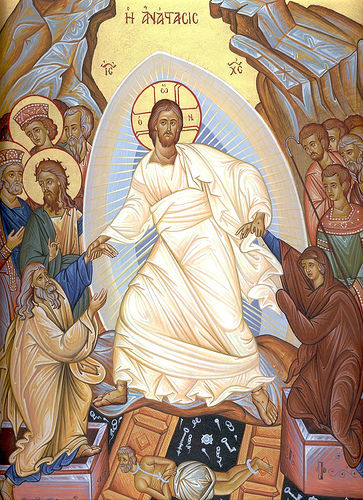
In Matthew’s telling of Easter morning, the first thing we notice is not joy. It’s not a celebration. It’s not even belief. It’s fear.
Mary Magdalene and “the other Mary” go to the tomb at dawn. The world, for them, has already ended once. They watched Jesus die. They saw the stone rolled into place. They are not expecting resurrection. They are carrying grief.
And then everything shakes. Matthew says there is a great earthquake. An angel descends. The stone is rolled away—not to let Jesus out, but to let them in, to see. The guards tremble and become like dead men. The whole scene is overwhelming, destabilizing, impossible.
And the angel says, “Do not be afraid.” Which is, of course, exactly what you say when something terrifying and world-altering has just happened. “Do not be afraid… He is not here; for he has been raised.” Before there is joy, before there is understanding, there is this: a word spoken into fear. A word that doesn’t deny the fear, but meets it.
That’s where hope begins in Matthew’s Gospel—not as a feeling, not as optimism, but as a word spoken into the very place where fear and loss still live. The women leave the tomb, Matthew tells us, “with fear and great joy.” Both at once. And that might be the most honest description of Easter faith we have.
Because hope, at least the kind that Easter proclaims, is not the absence of fear. It is not the denial of grief. It is not pretending that death doesn’t still wound us. Hope is what happens when something new breaks in – despite the fear and grief.
The women run to tell the disciples, and suddenly—Jesus meets them. Not in the tomb. Not in the place of death. But on the road. In motion. In the middle of their going. And his first word to them is simple: “Greetings.” It sounds almost ordinary. In Greek, it’s closer to “Rejoice,” but it’s also just a common greeting. As if resurrection doesn’t arrive with a trumpet blast, but with a voice we almost recognize.
And then:
“Do not be afraid.”
Again. Hope, it seems, needs to be said more than once. They take hold of his feet. They worship him. This is not a ghost, not an idea, not a metaphor. This is presence. This is relationship restored. This is life where there should only be absence. And then Jesus sends them:
“Go and tell my brothers…”
Go. Hope is not something to be kept. It moves. It sends. It creates witnesses. But let’s be honest about what kind of hope this is. This is not the kind of hope that says everything will go back to the way it was. It won’t. The risen Jesus still bears the marks of crucifixion. Resurrection does not erase the wounds; it transforms them.
This is not the kind of hope that promises we will avoid suffering. The same Gospel that proclaims resurrection will also speak of hardship, of mission, of risk. And this is not the kind of hope that depends on our certainty. The women are still afraid. The disciples, later in the chapter, will doubt.
And yet—Christ is risen anyway. That’s the heart of it. Easter hope does not depend on how strongly we believe. It depends on what God has done.
God has gone into the very depths of human fear, human violence, human death—and has not been overcome. The tomb is empty, not because the women were brave, not because the disciples were faithful, but because God is faithful. And that changes everything.
It means that the worst thing is never the last thing. It means that the places in our lives that feel sealed shut—places of grief, of regret, of exhaustion, of despair—are not beyond God’s reach. It means that even when the ground shakes beneath us, even when the future feels uncertain, even when fear is still very real, there is another word being spoken.
“Do not be afraid.”
Not because there is nothing to fear—but because fear does not get the final say. We live in a world that gives us plenty of reasons to be afraid. We carry our own private tombs—losses we cannot undo, questions we cannot answer, burdens we cannot easily lay down. Easter does not pretend those things aren’t real. But it tells us they are not ultimate. Because the story does not end at the cross. It does not end at the tomb. It does not end with what we can see or predict or control.
There is always more to the story, because God is still at work. And sometimes that “more” looks like an earthquake. Sometimes it looks like a space where something used to be. Sometimes it looks like a voice calling our name on the road, when we thought we were just going through the motions.
Hope, in Matthew’s Gospel, is not loud or triumphant at first. It is fragile, surprising, and almost unbelievable. It is carried by two women running with fear and great joy. It is spoken in a simple greeting. It is held onto, quite literally, as they grasp the feet of the risen Christ.
And then it is shared. “Go and tell…” That is our place in the story, too. Not as people who have everything figured out. Not as people who are never afraid. But as people who have heard a word, who have glimpsed something, who are learning—slowly, imperfectly—to trust that death does not win.
So we go. We go into a world that still knows Good Friday. We go into relationships that need healing, into communities that need hope, into ordinary days that may not feel particularly “resurrected.” And we carry this news—not as a slogan, not as an argument, but as a lived reality:
Christ is risen. Hope is alive. And fear, however loud it may be, is not the final word. Alleluia. Amen.


Comments