
Rachel’s Lament & Our Christmas Joy

Lessons, Christmas 2A: Jeremiah 31:7-14; Psalm 84; Ephesians 1:3-6, 15-19a; and, Matthew 2:13-23 (note the inclusion of verses 16-18)
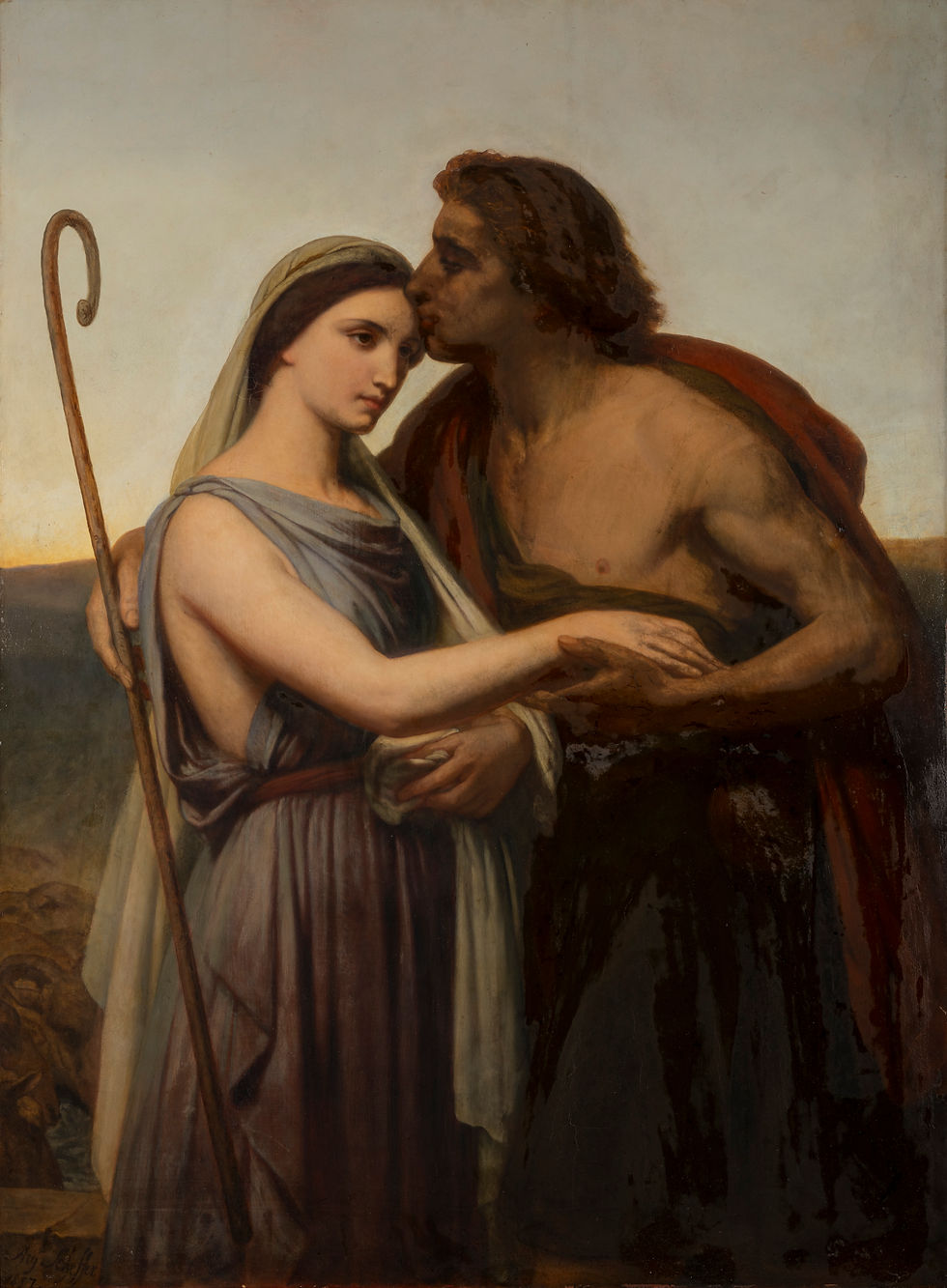
Amid the packages and wrappings, the ribbons and gatherings, the cookies and whatever remains of puddings and roast beast, Matthew’s telling of the first Christmas turns suddenly dark. Above the gentle comings and goings of Magi and shepherds, Matthew—and only Matthew—asks us to pause in our celebrations and listen for a voice that has been crying through the centuries. There is an urgency in his narrative, a summons to stop, to be still, and to hear.
In a dream, Joseph learns that Jesus—He who saves—is in mortal danger. Herod is searching for the child to destroy him, the child the Magi have named “King of the Jews,” the very title Herod clings to on behalf of Caesar. Joseph must flee to Egypt, the place where Israel’s story began. Egypt, where Pharaoh once ordered the murder of Hebrew boys. Egypt, where Moses alone survived that first genocide. And now Egypt becomes the refuge for Jesus and his family as they escape the violence about to unfold in Bethlehem.
It is no accident that the stories of Moses and Jesus have sustained the hope of oppressed peoples across the ages. Both testify that the God of Abraham, Isaac, Jacob, and Jesus acts on behalf of endangered lives. Yet suddenly, in our lectionary, we leap from the Holy Family’s flight to Joseph’s next dream announcing it is safe to return home. An angel gives the “all-clear.” But what has been left out? What lies between these two dreams?
“When Herod saw that he had been tricked by the wise men, he was infuriated, and he sent and killed all the children in and around Bethlehem who were two years old or under… Then was fulfilled what had been spoken through the prophet Jeremiah: A voice was heard in Ramah, wailing and loud lamentation, Rachel weeping for her children; she refused to be consoled, because they are no more.”
Rachel, Jacob’s beloved wife, bears Joseph—who later saves his family by bringing them to Egypt as refugees—and Benjamin, whose tribe is carried off to Babylon after the Assyrians destroy the First Temple. Jeremiah imagines Rachel as the archetypal mother who mourns and intercedes for her children, pleading for an end to their suffering and exile.
Matthew reimagines Rachel crying out again—this time for the infants slaughtered by Herod’s soldiers in Bethlehem, murdered to prevent Jesus from threatening Herod’s fragile grip on power. And Rachel continues to lament for all who suffer similar brutality at the hands of history’s endless parade of “Herods”—those who cling to power with violence: the Hitlers, Stalins, Khmer Rouge, and all who brutalize the “other” in their paranoid rage.
Matthew refuses to soften the story, unlike our lectionary’s trimmed version. He tells it fully to anchor Jesus in the long, painful history of his ancestors and to foreshadow the shape of his own life. Matthew wants us not only to hear Rachel’s lament but to join it—to weep for refugees and asylum seekers who, at this very moment, are in mortal danger, like Joseph and Benjamin and Jesus before them, and for all those who are “no more.”
When Joseph, Mary, and Jesus return, Bethlehem remains unsafe, so they resettle in Nazareth. It is easy to imagine Jesus growing up and asking why he never meets his cousins or extended family in Joseph’s hometown. Surely the story of Herod’s slaughter—of infants and the adults who died trying to protect them—is told again and again among the remnants of his earthly kin. Jesus, like Moses, is saved by the hand of God, a survivor of the massacre so that he might save a world still marked by sin, brokenness, and danger.
Each child under two represents a poem never written, music never composed, discoveries never made. We will never know how many died in Bethlehem in Herod’s attempt to thwart God’s saving grace, nor how many die in refugee camps today. So much human potential, culture, and imagination is lost.
Matthew includes this part of the story so those children will not be forgotten—so Rachel’s children will not be forgotten. And to remind us that such atrocities are committed by Herod and Hitler, not by the God of Abraham, Isaac, Jacob, and Jesus. Just as God intervened to save Rachel’s descendant Jesus, so God intervened after the Crucifixion by raising him from the dead. Matthew—and only Matthew—reminds us that the light wood of the manger is already the hard wood of the Cross.
We owe Matthew gratitude for telling the whole truth. In hearing what happened in Bethlehem, we are called to stop whatever occupies us during these Twelve Days of Christmas and listen. When we do, we can still hear Rachel’s lament—her weeping for those who are no more, her wailing for all God’s children. Above the noise of our holiday activity, we hear Jesus calling us to follow him into the work of saving those still at risk. He promises that we will do the works he does, and even greater works, in his name. This is the Good News of Christmas.
May we hear our Lord call us to stop, to be still, and to listen. Here and now—listen. What do you hear.

Comments