
Justice in Belonging

Lessons, Proper 12A: 1 Kings 3:5-12; Psalm 119:129-136, 45b; Romans 8:26-39; Matthew 13:31-33,44-52

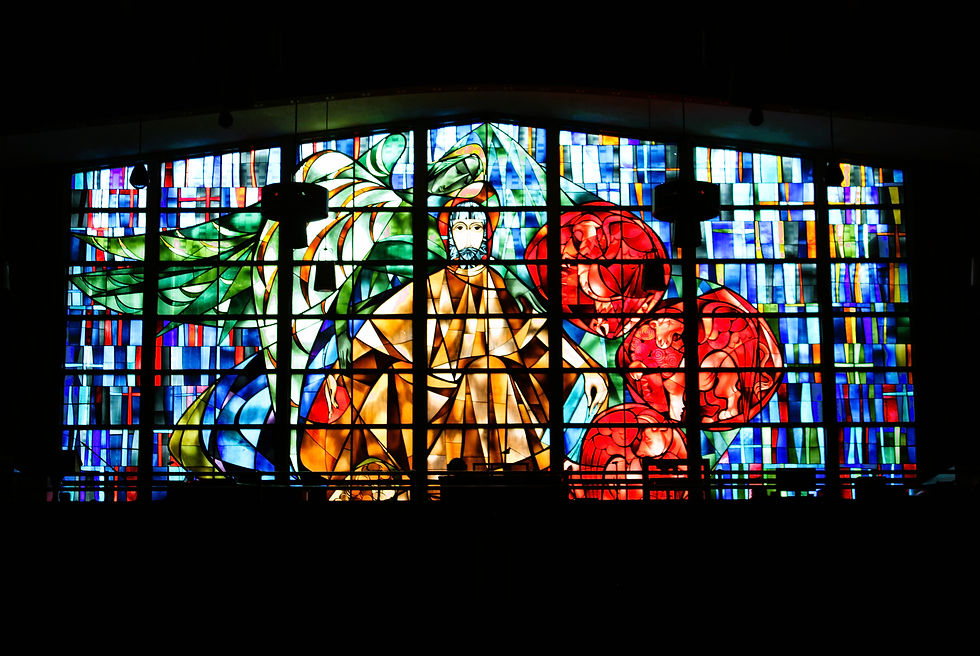
A few years ago, I sat in this sanctuary with sunlight pouring through the stained‑glass, and for the first time I felt something settle in me. I liked being here; more than that, I felt I belonged. It wasn’t sudden. It came after weeks of studying with you, talking with you, simply being with you. That moment was the fruit of relationship, of trust, of shared life.
And just a few days ago, I felt it again. This place feels like home. There is no calculation, no wondering whether I fit, no weighing or measuring. I simply know I am safe, welcomed, and loved.
And I keep thinking: What would the world be if every person knew that kind of belonging? If every human being, in every land, woke each morning knowing they were cherished, protected, and held by a community that recognized their worth? That is the heart of today’s readings — the insistence that belovedness is meant to be lived, and that belonging is the birthright of all creation.
Grace to you and peace from God our Father and the Lord Jesus Christ.
Today’s readings gather around a single, radiant truth: we belong to God — and because we belong to God, we are called to belong to one another. Belovedness is never a private comfort; it is a public vocation. It shapes how we see the world, how we respond to suffering, and how we imagine the future God longs to bring forth.
So let us turn to the passages before us and see how each one reveals the belovedness of belonging — the divine gift that becomes our shared calling.
Solomon’s Prayer: Belovedness as the Ground of Wisdom
In 1 Kings, Solomon stands at the threshold of leadership. God invites him to ask for anything, and Solomon—young, inexperienced, aware of his limits—asks for an understanding mind. He seeks wisdom not to dominate but to serve; not to secure his own power but to discern the needs of the people entrusted to him.
Solomon’s request is rooted in belonging. He knows himself to be God’s servant, and because he understands his life as belonging to God, he asks for the kind of wisdom that builds communities of justice, mercy, and peace. This is the wisdom the Church must seek today: wisdom that listens; wisdom that discerns; wisdom that refuses to turn away from suffering; wisdom that recognizes every human being as beloved of God.
Psalm 119: The Word That Gives Light
In Psalm 119, the psalmist proclaims, “Your decrees are wonderful; therefore I obey them with all my heart.” God’s word gives light—light that reveals truth, exposes injustice, and guides our feet toward compassion. The psalmist “sheds streams of tears” because people disregard God’s law. These are not tears of superiority but tears of grief for a world where God’s beloved creation is harmed, exploited, or forgotten.
To belong to God is to belong to one another—and that means letting our hearts break for what breaks God’s heart.
Romans 8: The Spirit Who Holds Us
Paul’s soaring words in Romans 8 remind us that nothing can separate us from the love of God. Not hardship, not persecution, not famine, not sword. Not even our own weakness. The Spirit “helps us in our weakness,” interceding with sighs too deep for words.
This is the foundation of Christian belonging: We are held. We are known. We are beloved. And because we are beloved, we are sent into the world as agents of God’s reconciling love—revealing our belovedness to others as a reminder of their own. Paul’s vision is cosmic: creation groans, humanity groans, the Spirit groans, and God’s love holds all of it. Christian belonging is never escapist; it is always deeply engaged with the world—its pain, its humiliation, its anger, its oppression, and its oppressing.
Matthew 13: The Kingdom as Small Seeds and Hidden Treasure
Finally, Jesus gives us images of the kingdom: a mustard seed, yeast hidden in flour, treasure buried in a field, a pearl of great value, a net gathering fish of every kind. Each image reveals a kingdom that begins small, works quietly, and gathers expansively—drawing all creation into God’s redeeming embrace.
Each image reveals something essential: the kingdom begins small, works quietly, is worth everything, and gathers all people into God’s redeeming embrace. To belong to God is to become soil where the mustard seed can grow. It is to become dough where the yeast can rise. It is to become people who recognize the treasure of God’s justice and give our lives to it — people who trust that even the smallest acts of mercy participate in God’s vast work of renewal.
Today, we cannot ignore the cries of people around the world living under the weight of war, displacement, and oppression. We grieve the staggering loss of life in Gaza and the devastation of Palestinian communities. Many human rights organizations and international observers have raised grave concerns about the scale of destruction and death; please confirm details with trusted sources. We lament the suffering of Palestinians whose homes, neighborhoods, and futures have been shattered. We lament every life lost, every child buried, every family displaced. And we lament the suffering of people in Sudan, Ukraine, Myanmar, Haiti, Iran, Yemen, and so many other places where violence has become a daily reality.
Our lament stretches to suffering closer to home as well. In recent months, immigrants fleeing violence and poverty have been killed during encounters with federal agents — lives cut short in moments that should have been marked by protection, due process, and care. These deaths, too, cry out to heaven. They remind us that belonging is not merely a spiritual truth but a moral imperative: every person, regardless of citizenship or status, bears God’s image and is worthy of safety, dignity, and compassion.
Christian lament is not partisan. It is not ideological. It is not a geopolitical strategy. Christian lament is simply love refusing to look away.
What It Means to Bear Fruit Today
So what does all this mean for us — here, in this moment? It means allowing God’s word to take root in us so deeply that it shapes our posture toward the world. It means refusing to dehumanize any person, even in our grief or anger or fear. It means advocating for peace, dignity, and safety for all God’s children. It means supporting humanitarian relief, speaking truthfully about suffering, and resisting any narrative that justifies violence against civilians.
It means cultivating a community where belonging is not theoretical but embodied — where the lonely find companionship, the fearful find courage, the marginalized find welcome, and the weary find rest. It means remembering that justice is never an abstract ideal but a concrete expression of love.
The Spirit Helps Us in Our Weakness
And through all of this, Paul reminds us: the Spirit helps us in our weakness.
We do not build the kingdom alone.
We do not heal the world alone.
We do not carry the weight of global suffering alone.
The Spirit intercedes.
The Spirit strengthens.
The Spirit guides.
The Spirit turns our small acts of faithfulness into nets that gather all kinds of fish.
You are beloved. You belong. No exceptions.
And because you belong to God, you are invited to embody God’s dream for the world — to be good soil, to receive the word, to bear the fruit of justice, mercy, and peace. To let others know that they, too, are beloved. That they, too, belong. No exceptions.
Let us trust that the Spirit, who helps us in our weakness, will accomplish in us far more than we can ask or imagine. Amen.

Comments